
How Long Do Sleep Aids Stay in Your System the Next Morning?
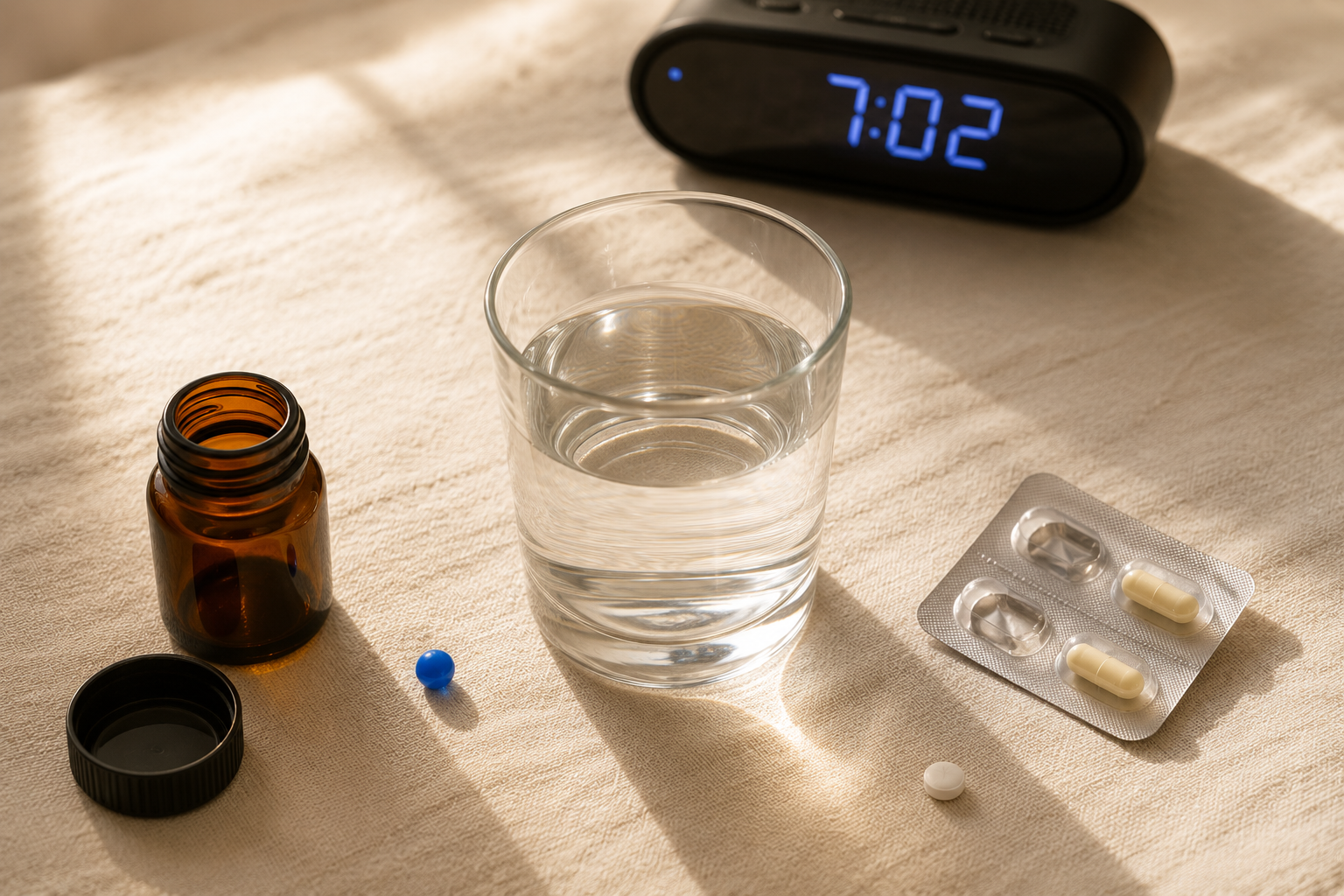
You took a sleep aid last night and woke up feeling like you never quite came back online. The grogginess, the slow thinking, the feeling of moving through fog — these are not just poor sleep. In many cases, they are the pharmacological aftereffect of a drug that is still measurably active in your brain hours after you got up.
Whether that happens — and how badly — comes down almost entirely to which sleep aid you took. The difference between melatonin and an over-the-counter antihistamine sleep aid is not just a difference in how they work. It is a difference of an order of magnitude in how long they stay in your system. And for some people, particularly women taking zolpidem and older adults taking any of these drugs, the residual effects the next morning are significant enough to affect driving ability — something the FDA has formally warned about.
Here is how the main categories of sleep aids compare, in terms of half-life, next-morning presence, and the practical implications.
What "still in your system" actually means
A drug's half-life is the time it takes for blood concentration to drop by half. Using the standard pharmacokinetic rule of thumb, five half-lives represents roughly complete clearance — less than about 3% of the original dose remaining. But "complete clearance" and "no longer affecting you" are not the same thing. For drugs that act on the brain, what matters is not just whether the molecule is in the blood, but whether enough of it is still binding to receptors to produce effects.
With that distinction in mind, the relevant question is not only when a sleep aid clears the bloodstream, but whether enough remains the next morning to impair alertness, reaction time, or judgment. The answers differ dramatically across the four main types.
Melatonin: clears before you wake up
Melatonin is the shortest-acting of the common sleep aids, and for most people taking a standard immediate-release dose at bedtime, it is essentially gone before morning.
The half-life of immediate-release melatonin is roughly 20 to 50 minutes in healthy adults, with some pharmacokinetic studies placing it closer to one to two hours depending on the formulation and individual. Run the five-half-lives calculation and you get full clearance somewhere between three and five hours after the dose — well before the end of a normal night's sleep. Blood levels of melatonin peak within about an hour of taking it and then fall steeply.
The important qualifier here is extended-release formulations. Prolonged-release melatonin products have half-lives in the range of three to five hours, meaning they are designed to maintain elevated levels through the night — and they do carry a higher risk of morning residual effects than immediate-release versions, especially at higher doses.
A second qualifier is interactions. The enzyme that clears melatonin from the body (CYP1A2) is inhibited by certain antidepressants, particularly fluvoxamine. In people on that medication, melatonin levels can be elevated significantly, which changes its clearance substantially.
It is also worth noting that melatonin is classified as a dietary supplement in the United States, not a prescription drug. The FDA does not regulate it with the same rigor as a medication, which means the actual dose in a given supplement may not match the label precisely — a real consideration given that some research suggests much lower doses may be effective.
Zolpidem: short half-life, but the math still matters at breakfast
Zolpidem (Ambien) is the most prescribed prescription sleep aid in the United States, and it has a reputation for being relatively short-acting. That reputation is largely earned — its immediate-release half-life is about 2.5 hours, and most people taking a standard bedtime dose will clear the majority of it during a full night's sleep.
But "most" and "majority" are doing important work in that sentence. After eight hours, the five-half-lives rule says roughly 13 to 15% of an immediate-release zolpidem dose is still circulating. The FDA has established that blood levels above 50 nanograms per milliliter are associated with impairment significant enough to increase the risk of a motor vehicle accident. In some patients — particularly women, who on average clear zolpidem about 45% more slowly than men — morning blood levels can still be in that range.
This was significant enough that in January 2013 the FDA issued a drug safety communication specifically about next-morning impairment from zolpidem, and required lower recommended doses for women on all major zolpidem products. The agency also reminded the public that all insomnia drugs can impair driving and other activities requiring alertness the morning after use, even when the person feels subjectively awake. The label warning is explicit: patients should not take zolpidem if less than a full night's sleep (seven to eight hours) remains, because not enough clearance time will have passed.
Extended-release zolpidem (Ambien CR) presents an additional layer of risk: its controlled-release formulation is specifically designed to maintain active blood levels longer into the night, which means higher morning levels for some patients. The FDA warning about next-morning impairment was, if anything, stronger for the extended-release formulation.
A further complicating factor: zolpidem, like all prescription sleep aids, carries a risk of complex sleep behaviors — episodes of sleepwalking, sleep-driving, or other behaviors carried out while not fully awake and with no memory afterward. These are listed as rare but serious risks on the FDA label and apply to several other prescription sleep aids as well.
OTC antihistamines: the groggiest class, by the numbers
Over-the-counter sleep aids built around antihistamines — diphenhydramine (in ZzzQuil, Tylenol PM, Benadryl, and many store brands) and doxylamine (in some Unisom products) — are widely used partly because they are cheap, accessible, and do not require a prescription. But their pharmacokinetics tell a story that surprises many people who assume "OTC" means "mild."
Diphenhydramine has an elimination half-life in healthy adults of approximately nine hours, with a range from about seven to twelve hours per clinical pharmacokinetic data reported in StatPearls. That is three to four times longer than zolpidem's half-life. After eight hours of sleep, roughly half of an evening diphenhydramine dose is still in circulation. And because diphenhydramine works by blocking histamine receptors in the brain — the same receptors involved in wakefulness — that remaining drug is still exerting a sedative effect.
The brain-level evidence is striking: a positron emission tomography (PET) study found that cortical histamine receptor occupancy remained at about 44.7% the morning after a nighttime dose of diphenhydramine. In other words, nearly half the receptors relevant to alertness and wakefulness were still being blocked when subjects woke up. Research has also found that diphenhydramine impairs driving performance in ways that parallel alcohol intoxication, including when people do not feel subjectively impaired — a phenomenon sometimes described as "feeling fine but not fine."
Doxylamine has a half-life approximately twice that of diphenhydramine — around ten to twelve hours in healthy adults, extending to roughly fifteen hours in older adults. The longer half-life means doxylamine is more effective at sustaining sleep through the night, but it also means more consistent and pronounced next-day sedation.
For people over 65, both drugs carry particular cautions. The Beers Criteria, a standard reference for medication safety in older adults, classifies diphenhydramine as potentially inappropriate for routine use in this age group. In older adults, slower metabolism means the half-life stretches to roughly thirteen to fourteen hours for diphenhydramine — meaning substantially more of the drug is present the next morning than in a younger person who took the same dose.
Prescription benzodiazepines: it depends on which one
Benzodiazepines prescribed for sleep — a class that includes temazepam (Restoril), triazolam, and historically others — span an enormous range of half-lives, and that range determines almost everything about their next-morning impact.
Temazepam has a half-life typically cited in the range of eight to twenty-two hours, with many sources putting the clinical average around sixteen hours. The FDA label for Restoril notes that residual effects are "essentially absent" at recommended doses for temazepam specifically, distinguishing it from longer-acting agents. That said, temazepam is longer-acting than zolpidem and does accumulate with repeated dosing.
At the far end of the spectrum, long-acting benzodiazepines like flurazepam have active metabolites with half-lives of forty hours or more. These drugs can genuinely accumulate over days of repeated dosing, producing a carry-over sedation that grows rather than resolves with each night's use.
Benzodiazepines are controlled substances (Schedule IV), carry significant risk of dependence and withdrawal with regular use, and are not intended for long-term sleep management. These are important considerations that go beyond next-morning grogginess.
The quantitative picture: who is still carrying the load at 7 AM
If someone takes a sleep aid at 11 PM and wakes at 7 AM — eight hours later — here is roughly how much of each type remains, using the five-half-lives clearance principle:
Melatonin (immediate-release, half-life ~45 minutes): after eight hours, the equivalent of more than ten half-lives have passed, leaving well under 1% of the dose present. Effectively cleared.
Zolpidem immediate-release (half-life ~2.5 hours): roughly three half-lives in eight hours, leaving about 13% of the dose in circulation. Still detectable and potentially impairing in sensitive individuals.
Diphenhydramine (half-life ~9 hours): less than one full half-life in eight hours, leaving about 54% of the original dose still present. Nearly half the drug remains.
Doxylamine (half-life ~11 hours): even less clearance in eight hours, leaving roughly 60% or more still in the system.
These are approximations — individual metabolism, age, liver function, body composition, and co-medications all shift these numbers. But as a framework for understanding why some people wake up sharp and others feel sedated for hours, the half-life math is the central explanation.
What this means in practice
The morning-after experience with a sleep aid is not random. It is a predictable consequence of how long the drug takes to clear, modified by individual factors — age, sex, liver function, genetics — that affect metabolism. The practical points are:
First, if you need to drive or do anything requiring full alertness in the morning, the type and timing of sleep aid matters. The FDA's warning about zolpidem explicitly covers morning activities, even when a person feels awake. With antihistamine sleep aids, the same concern applies, even if the label does not carry the same formal warning.
Second, older adults are disproportionately affected by residual sedation, because slower metabolism means longer half-lives across nearly all of these drugs. The standard dose for a 35-year-old and a 70-year-old may produce very different morning-after experiences.
Third, "over the counter" does not mean "out of your system by morning." Diphenhydramine and doxylamine are not short-acting drugs. Their accessibility makes them easy to underestimate.
None of this is a reason to avoid sleep aids when they are appropriate — poor sleep has its own real costs. It is a reason to match the drug to the situation, to be cautious about morning tasks on days after use, and to have a conversation with a healthcare provider about which option makes sense for your specific circumstances.
Sources
- U.S. Food & Drug Administration. Questions and Answers: Risk of next-morning impairment after use of insomnia drugs. Drug Safety Communication, January 2013. https://www.fda.gov/drugs/drug-safety-and-availability/questions-and-answers-risk-next-morning-impairment-after-use-insomnia-drugs-fda-requires-lower
- U.S. Food & Drug Administration. Ambien (zolpidem tartrate) Prescribing Information. https://www.accessdata.fda.gov/drugsatfda_docs/label/2022/019908s40s044s047lbl.pdf
- Verster JC, et al. Residual Effects of Low-Dose Sublingual Zolpidem on Highway Driving Performance the Morning after Middle-of-the-Night Use. J Clin Sleep Med. 2014. https://pmc.ncbi.nlm.nih.gov/articles/PMC3920314/
- Gunja N. In the Zzz Zone: The Effects of Z-Drugs on Human Performance and Driving. J Med Toxicol. 2013. https://pmc.ncbi.nlm.nih.gov/articles/PMC3657033/
- Blass DM, et al. Zolpidem and Driving Impairment — Identifying Persons at Risk. N Engl J Med. 2013;368:689-691. https://www.nejm.org/doi/full/10.1056/NEJMp1307972
- Scherder R, et al. Diphenhydramine Toxicity. StatPearls (NCBI Bookshelf). https://www.ncbi.nlm.nih.gov/books/NBK557578/
- Sack RL, et al. Melatonin. StatPearls (NCBI Bookshelf). https://www.ncbi.nlm.nih.gov/books/NBK534823/
- U.S. Food & Drug Administration. Restoril (temazepam) Prescribing Information. https://www.accessdata.fda.gov/drugsatfda_docs/label/2016/018163s064lbl.pdf
- Morin AK, et al. Impact of a US Food and Drug Administration Drug Safety Communication on Zolpidem Dosing: An Observational Retrospective Cohort. PMC. 2015. https://pmc.ncbi.nlm.nih.gov/articles/PMC4560192/