
Metformin and Surgery: Do You Really Stop It 48 Hours Before?
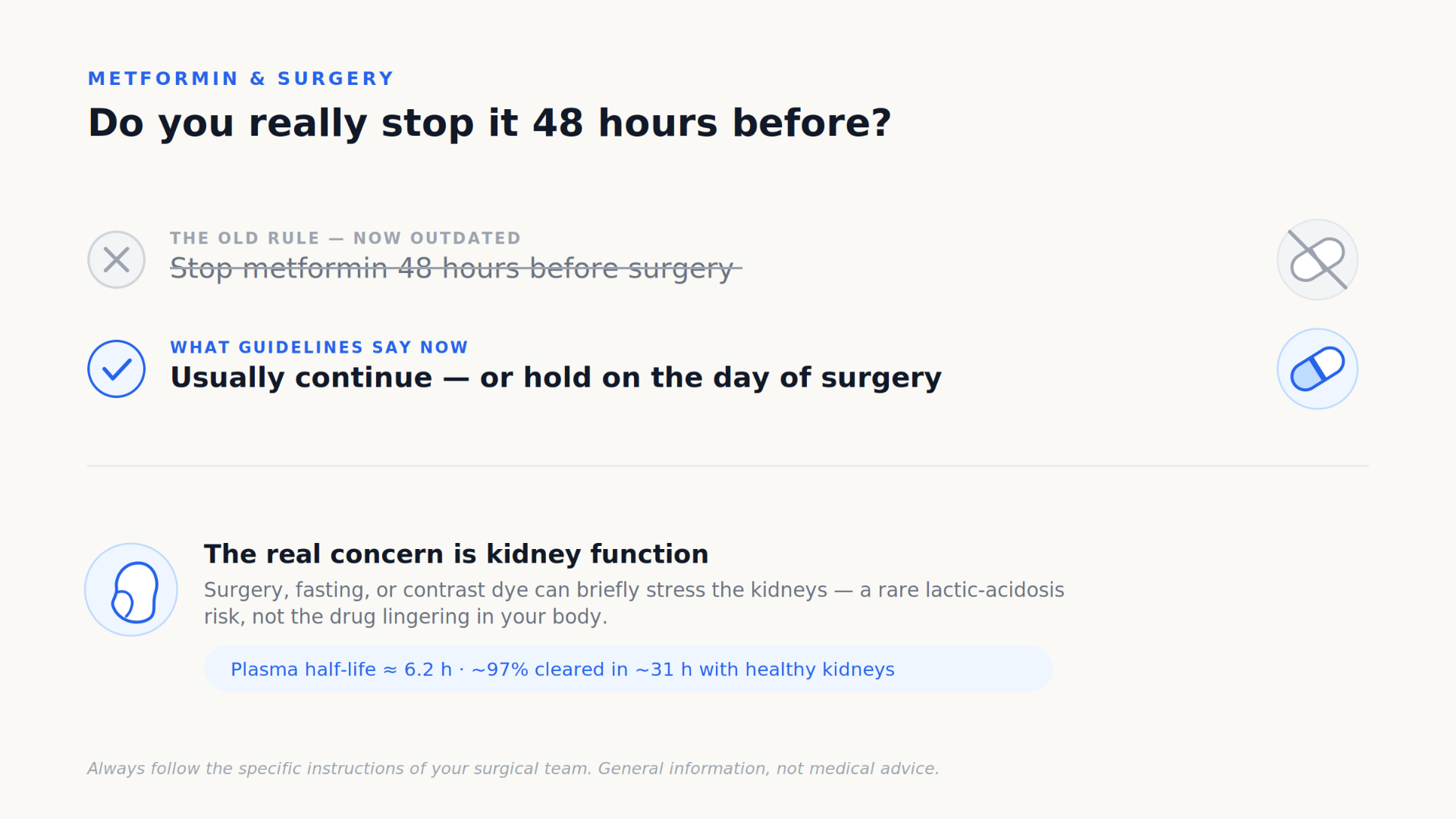
If you take metformin and have surgery coming up, you have probably heard that you need to stop it 48 hours beforehand. It is one of the most repeated pieces of pre-surgery advice — and for most people, it is no longer what the guidelines say.
Here is the short version: for someone with normal kidney function, current guidelines generally say to hold metformin on the day of surgery, and some say to keep taking it as usual. The strict "48 hours before" rule is mostly a holdover from an older instruction about contrast dye, and the real reason metformin gets paused at all has nothing to do with the drug lingering in your body. It is about protecting against a rare complication if your kidneys are briefly put under stress.
This article walks through what the guidelines actually recommend now, where the 48-hour idea came from, and why metformin's half-life shows that "lingering" was never the concern. None of this is a substitute for the instructions your own surgical team gives you — those always win, because they are based on your kidney function, your exact regimen, and your procedure.
What the guidelines actually say now
There is no single global rule, and that is part of why the advice you hear varies so much. A 2025 comparison of major guidelines lays out the differences clearly. The American Diabetes Association recommends withholding metformin on the day of surgery. The main UK and Irish guidelines — from the Centre for Perioperative Care, the Joint British Diabetes Societies, and the anaesthetists' association — go further and generally allow people taking once- or twice-daily metformin to take it as usual on the day of surgery, as long as the fast is short (no more than a missed meal or so). The Society for Ambulatory Anesthesia advises taking it on the day of surgery unless kidney function is reduced (an eGFR below 45) or the procedure involves drugs that are hard on the kidneys.
Notice what is missing from all of those: a blanket "stop 48 hours before." A 2023 review in the British Journal of Anaesthesia put it plainly — patients having elective surgery should generally continue metformin, including on the day of surgery. The medication that typically gets stopped days ahead is a different diabetes class, the SGLT-2 inhibitors, which are usually paused around three days before. The two often get blurred together in people's memories.
So where did "48 hours" come from?
The number is real, but it has drifted from its original context. Years ago, the FDA label for metformin told patients to stop the drug before any X-ray procedure using iodinated contrast dye, keep it stopped for 48 hours afterward, and restart only once a blood test confirmed their kidney function was back to normal. That older rule did not distinguish between healthy kidneys and impaired ones, so it was applied broadly — and it stuck in clinical habit and patient memory.
In 2016 the FDA revised it. The current label only calls for stopping metformin at or before contrast imaging in specific situations: reduced kidney function (an eGFR between 30 and 60), a history of liver disease, alcohol use disorder, or heart failure, or when the dye is injected into an artery. In those cases, kidney function is rechecked 48 hours after the procedure, and metformin is restarted if it is stable. So the surviving "48 hours" is mostly the after window — the recheck period following contrast — not a universal countdown before surgery. UK guidance keeps a version of this too: if contrast is being used and kidney function is already reduced, metformin is omitted on the day and for the 48 hours afterward.
The real reason: lactic acidosis and your kidneys
Strip away the timing details and one concern sits underneath all of it: a rare complication called metformin-associated lactic acidosis.
Metformin is cleared from your body almost entirely by your kidneys, and it leaves unchanged — your liver does not break it down. Surgery can briefly stress the kidneys in several ways at once: fasting and restricted fluids before the procedure, blood-pressure dips under anesthesia, fluid shifts during a major operation, and sometimes contrast dye for imaging. If kidney function dips and metformin cannot be cleared as usual, levels can climb. At the same time, metformin reduces how much lactate the liver takes up, so lactate can build. Put those together in the wrong circumstances and the result, rarely, is lactic acidosis — a serious disturbance in the body's acid balance.
The word that matters there is rarely. The complication shows up in fewer than about 10 cases per 100,000 patient-years of metformin use, and newer analyses suggest metformin's role may even be overstated, with other illnesses doing much of the damage in the cases that do occur. The pause around surgery is a precaution against a low-probability but serious event — not a sign that the drug is dangerous to have in your system day to day.
The half-life angle: why "lingering" isn't the issue
This is where metformin's pharmacokinetics are clarifying. Metformin's plasma half-life is only about 6.2 hours. Roughly 90% of an absorbed dose is gone through the kidneys within the first 24 hours. Run the standard "five half-lives" rule of thumb and you get full clearance in about 31 hours — so in a person with normal kidney function, the drug is essentially cleared within a day to a day and a half. (You can see how that curve plays out on our metformin clearance page.)
In other words, if metformin simply needed time to clear, you would never need anything close to 48 hours — a single day would more than cover it. The reason the concern is framed around days, and around kidney testing rather than a stopwatch, is that the whole question depends on whether your kidneys keep working normally through the procedure. With healthy kidneys, metformin is a fast-clearing drug. The caution exists for the scenario where the kidneys briefly stop keeping up. That is also why the guidance leans on eGFR (a kidney-function number) instead of a fixed countdown.
When stricter timing genuinely applies
The relaxed, "day of surgery" approach is built around otherwise-healthy people having routine procedures. Several factors push toward more caution, earlier pausing, and closer kidney monitoring:
- Reduced kidney function going in (guidelines use cutoffs around an eGFR of 45 to 60, depending on the source).
- Iodinated contrast dye, especially injected into an artery, or contrast combined with already-reduced kidney function.
- A history of liver disease, heart failure, or alcohol use disorder, each of which raises the baseline lactic-acidosis risk.
- Major surgery with significant blood loss or large fluid shifts, or any emergency or unstable situation.
In these situations the timing and the after-procedure kidney recheck carry real weight, and your team may well stop metformin earlier and restart it later.
Restarting after surgery
Metformin is generally restarted once you are eating and drinking normally again, your blood pressure and circulation are stable, and a check confirms your kidney function is adequate — often in the day or two after an uncomplicated procedure. As with stopping, this is a decision your care team makes based on how recovery is going, not something to restart on your own the moment you get home.
What this means for you
If you take metformin and surgery is on the calendar, the practical move is simple: follow the specific instructions from your pre-operative or surgical team, and ask them directly when to stop and when to restart. Those instructions are tailored to your kidney function, your exact metformin schedule, the type of procedure, and whether contrast will be used — variables a general rule cannot account for. Bring a complete list of your medications to your pre-op appointment, and do not stop, start, or change any of them on your own. The "48 hours" you may have heard is a reasonable thing to ask about, but for many people it is no longer the answer.
Sources
- National Institute of Mental Health (NIMH) — Mental Health Medications. https://www.nimh.nih.gov/health/topics/mental-health-medications
- Edwards Z, Preuss CV. GABA Receptor Positive Allosteric Modulators. StatPearls (NCBI Bookshelf). https://www.ncbi.nlm.nih.gov/books/NBK554443/
- Selective Serotonin Reuptake Inhibitors. StatPearls (NCBI Bookshelf). https://www.ncbi.nlm.nih.gov/books/NBK554406/
- Wilson TK, Tripp J. Buspirone. StatPearls (NCBI Bookshelf). https://www.ncbi.nlm.nih.gov/books/NBK531477/
- Alprazolam. StatPearls (NCBI Bookshelf). https://www.ncbi.nlm.nih.gov/books/NBK538165/
- Propranolol. StatPearls (NCBI Bookshelf). https://www.ncbi.nlm.nih.gov/books/NBK557801/
- U.S. Food & Drug Administration — XANAX (alprazolam) Prescribing Information. https://www.accessdata.fda.gov/drugsatfda_docs/label/2011/018276s045lbl.pdf