
Drug-Drug Interactions: How Two Medications Can Change Each Other's Half-Life
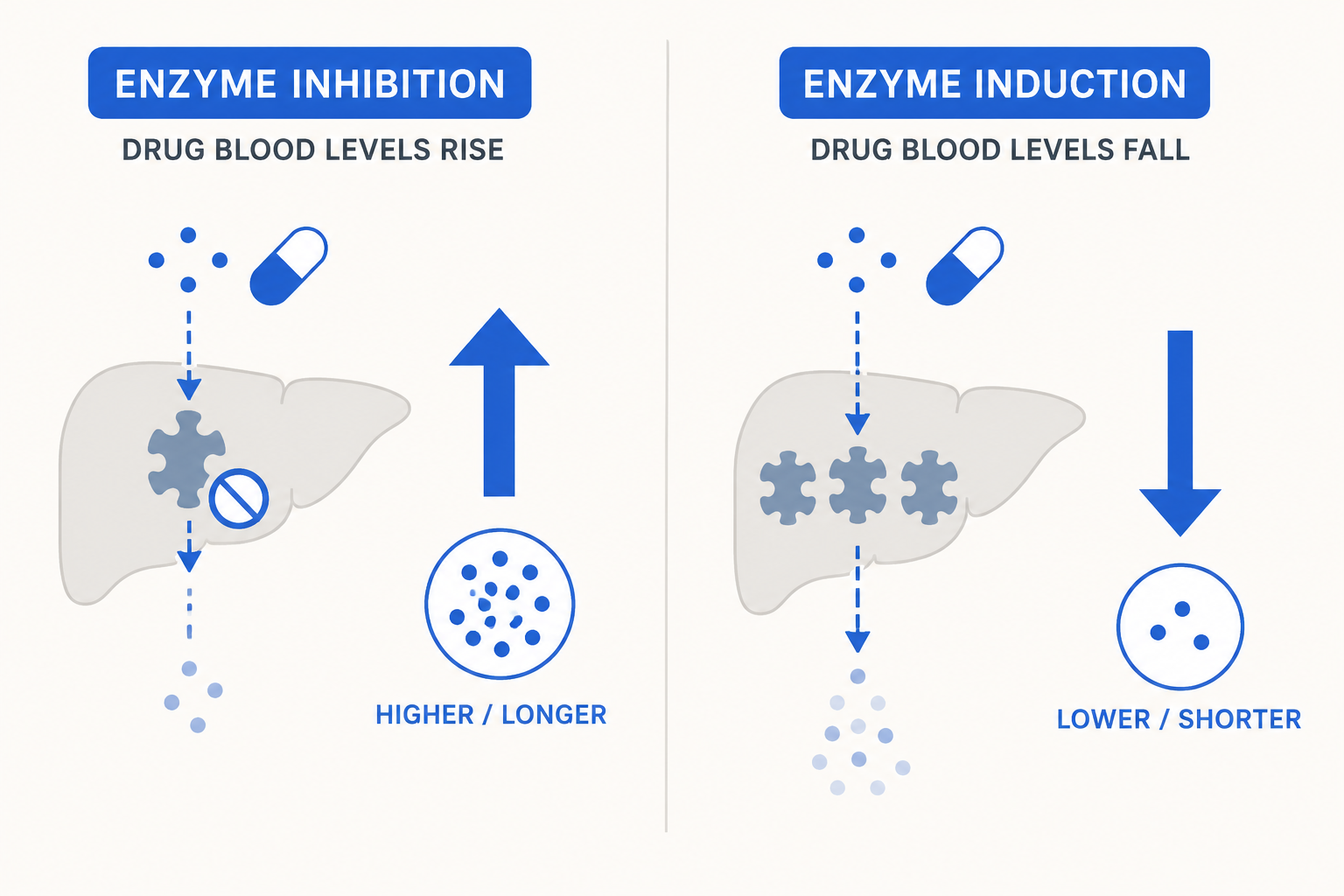
Most people think of a drug's half-life as a fixed property — take this pill, and it will leave your body in roughly this many hours. That is true when you take the drug alone. Add a second medication that uses the same metabolic pathway, and the half-life of one or both can shift dramatically. A drug that normally clears in a few hours might linger for days. A drug taken to control cholesterol might be metabolized so quickly it barely works. The same enzyme in the liver — or the gut wall — is at the center of both stories.
Understanding how this happens does not require a pharmacology degree. A handful of mechanisms explain the vast majority of clinically significant interactions, and the same names keep showing up across dozens of drug pairs. Here is a plain-English tour of those mechanisms, with real examples where the numbers are well-documented.
The enzyme assembly line
Your liver is, among other things, a disassembly plant for foreign chemicals. Most drugs are broken down by a family of enzymes called cytochrome P450 — CYP450 for short. These enzymes convert fat-soluble drug molecules into more water-soluble forms that the kidneys can excrete. CYP3A4 is the busiest of them, handling more than half of all prescription drugs currently on the market. Others, like CYP2C9 and CYP2D6, are responsible for large and clinically important groups of medications.
The rate at which an enzyme works determines how quickly a drug is cleared and, by extension, how long it stays in the body at active concentrations. That rate is not fixed when multiple drugs are competing for the same enzyme. Two drugs can collide on the assembly line in two fundamentally different ways: one drug can slow the enzyme down, or one drug can crank it up.
Inhibition: the enzyme gets blocked, and levels rise
When one drug blocks or competes with a CYP enzyme, the other drug waiting to be metabolized has nowhere to go. It accumulates. Its half-life extends. Its blood concentration climbs. If the drug has a narrow therapeutic window — a small gap between the effective dose and the dangerous dose — this can become a safety problem quickly.
The warfarin-and-fluconazole interaction is one of the most studied and clinically significant examples. Warfarin, the anticoagulant, is primarily metabolized by CYP2C9 — specifically the more potent S-enantiomer of the drug, which is responsible for most of its blood-thinning effect. Fluconazole, a common antifungal, is a strong inhibitor of CYP2C9. When the two are given together, clinical studies have found that fluconazole inhibits the CYP2C9-dependent clearance of S-warfarin by roughly 70%. The anticoagulant effect builds, and patients stabilized on a consistent warfarin dose can develop INR values well into dangerous territory within days. Published guidance from anticoagulation specialists notes that patients typically need a 20 to 50 percent reduction in their warfarin dose when fluconazole is added, and close monitoring within a few days of starting the combination — not in a week, because serious INR elevations can appear well before that.
Warfarin is not unusual. Any drug with a narrow therapeutic window that depends heavily on a single CYP enzyme is a candidate for this kind of interaction.
Not all inhibition works the same way
There is an important distinction between competitive inhibition and mechanism-based (or "irreversible") inhibition, because the two behave very differently over time.
Competitive inhibition works like two cars trying to fit into one parking spot: as long as the inhibitor is in the body, it competes with the substrate drug for the enzyme's active site. When the inhibitor clears, the competition ends and the enzyme returns to normal. The interaction fades within hours to days, tracking roughly with the inhibitor's own half-life.
Mechanism-based inhibition is different. Some drugs do not just compete with the enzyme — they chemically inactivate it, binding irreversibly. The enzyme is permanently disabled. The only way normal metabolic capacity returns is for the body to synthesize new enzyme, which takes days. Paroxetine, the antidepressant, is a notable example: it is both a substrate of CYP2D6 and a potent mechanism-based inhibitor of the same enzyme. With continued use, paroxetine essentially inactivates the enzyme it depends on to clear itself, contributing to the non-linear, accumulating pharmacokinetics noted on its FDA-approved label. A similar pattern applies to omeprazole, a proton pump inhibitor and mechanism-based inhibitor of CYP2C19.
The practical takeaway: stopping a competitive inhibitor relatively quickly reverses the interaction. Stopping a mechanism-based inhibitor does not — the effect lingers until the liver regenerates the enzyme.
Induction: the enzyme gets supercharged, and levels fall
The opposite problem is enzyme induction. Some drugs do not block the enzyme — they stimulate the liver to produce more of it. More enzyme means faster clearance, shorter effective half-life, and lower blood concentrations of any co-administered drug sharing that pathway. A medication taken at a dose that was working well can become ineffective because it is being eliminated faster than expected.
Rifampin, an antibiotic used primarily for tuberculosis, is one of the strongest CYP3A4 inducers known. Its effect on statins illustrates the magnitude clearly. In a controlled crossover study, healthy volunteers who received a five-day course of rifampin (600 mg daily) before a single dose of simvastatin showed plasma concentrations of simvastatin acid reduced by more than 90 percent compared to simvastatin given alone. Across CYP3A4-dependent statins as a class — including lovastatin and atorvastatin — strong CYP3A4 inducers have been shown to reduce drug exposure (AUC) by 53 to 82 percent. A patient on a stable statin dose who starts rifampin for a tuberculosis infection could find their cholesterol control essentially dismantled while the antibiotic course continues.
Rifampin is not the only inducer that matters clinically. Carbamazepine (used for seizures), phenytoin, and even St. John's Wort — an herbal supplement — are significant CYP3A4 inducers that can reduce the effectiveness of dozens of co-administered drugs.
Enzyme induction also has a distinctive time course. Because the effect depends on new enzyme synthesis, full induction typically takes one to two weeks of daily exposure to the inducing drug to reach its peak. The reversal after stopping the inducer is similarly gradual. This delayed onset and offset can catch prescribers and patients off guard, especially when a new drug or supplement is added or removed without adjusting the medications that depend on the same pathway.
When food is the inhibitor: grapefruit
The same CYP3A4 enzyme active in the liver also lines the gut wall, where it handles first-pass metabolism of orally taken drugs before they even reach the bloodstream. Grapefruit juice inhibits this intestinal CYP3A4 — not through a drug at all, but through naturally occurring compounds called furanocoumarins, particularly bergamottin and 6,7-dihydroxybergamottin. These compounds inactivate CYP3A4 irreversibly in the gut wall, and a single glass of grapefruit juice can suppress the enzyme for 24 hours or more.
For drugs with low oral bioavailability that depend heavily on CYP3A4 for first-pass metabolism — felodipine (a calcium channel blocker), simvastatin, certain benzodiazepines, some immunosuppressants — grapefruit juice can meaningfully raise blood concentrations. In one controlled study, felodipine concentrations in some subjects were up to eight times higher when taken with grapefruit juice versus water, depending on baseline intestinal CYP3A4 levels. The original discovery was accidental: researchers used grapefruit juice to mask the taste of alcohol in a blood pressure study, and found unexpectedly elevated felodipine levels that later turned out to have nothing to do with the alcohol.
The grapefruit story is a useful reminder that "drug-drug interaction" is really "drug-metabolism interaction" — and the second drug does not have to be a prescription medicine to change how the first one behaves.
Why individual variation matters
Every CYP enzyme interaction plays out differently between individuals, and sometimes dramatically so. CYP3A4 activity can vary up to 40-fold in expression between people based on genetics, age, and other factors. CYP2D6 is even more variable: people can be genetically classified as poor metabolizers, intermediate metabolizers, extensive metabolizers, or ultra-rapid metabolizers, and the same dose of a drug metabolized by CYP2D6 can produce very different blood concentrations depending on which category a person falls into. Add an inhibitor or inducer on top of existing genetic variability, and predicting the outcome in any individual becomes a genuine clinical challenge — which is why monitoring and dose adjustment, rather than a fixed rule, are the standard clinical response to most significant interactions.
The quantitative angle: same drug, very different half-lives
The practical meaning of these shifts is clearest when you see the numbers side by side. Warfarin's effective half-life runs roughly 40 hours when taken alone. Add a strong CYP2C9 inhibitor like fluconazole, and the clearance pathway responsible for most of its activity is blocked by about 70 percent — the drug lingers far longer than expected at the same dose, with blood-thinning activity that accumulates over days. On the other side, a CYP3A4-dependent statin that takes hours to clear can see its plasma concentration cut by more than 90 percent when a strong inducer like rifampin is present — producing blood levels so low that the therapeutic effect is negligible. Same molecule, same dose, same patient's kidneys — different co-medication, entirely different pharmacokinetics.
This is the core insight behind why reviewing a full medication list matters before prescribing anything new. A drug's labeled half-life is always measured in isolation. In a real patient on multiple medications, the actual half-life can be shorter or longer by a substantial margin.
What to take from this
Drug-drug interactions via shared metabolic enzymes are common, well-characterized, and largely predictable if the pathways are known. The practical points are:
- Any time a new medication is added or removed, especially one known to be a CYP inhibitor or inducer, the behavior of other drugs on the same pathway can shift — sometimes significantly.
- The effect is not always immediate: induction takes days to weeks to reach its peak; mechanism-based inhibition outlasts the inhibitor itself.
- Food, supplements, and herbal products can participate in the same interactions, not just prescription drugs.
- The same interaction can produce very different outcomes in different people depending on their baseline enzyme activity.
None of this means combination therapy is dangerous — most drug combinations are prescribed without significant interaction risk, and clinicians and pharmacists routinely review potential interactions before prescribing. It does mean that a full and current medication list, including supplements and over-the-counter products, is one of the most useful things you can bring to any clinical appointment.
Sources
- Nair PC, et al. A Review of CYP-Mediated Drug Interactions: Mechanisms and In Vitro Drug-Drug Interaction Assessment. Biomolecules. 2024;14(1):99. https://www.mdpi.com/2218-273X/14/1/99
- Deodhar M, et al. Mechanisms of CYP450 Inhibition: Understanding Drug-Drug Interactions Due to Mechanism-Based Inhibition in Clinical Practice. Pharmaceutics. 2020;12(9):846. https://pmc.ncbi.nlm.nih.gov/articles/PMC7557591/
- U.S. Food & Drug Administration. Clinical Drug Interaction Studies — Cytochrome P450 Enzyme- and Transporter-Mediated Drug Interactions. Guidance for Industry. 2020. https://www.fda.gov/
- Rettie AE, et al. Warfarin-fluconazole. II. A metabolically based drug interaction: in vivo studies. Drug Metab Dispos. 1996. https://pubmed.ncbi.nlm.nih.gov/8801057/
- Wiggins BS, et al. Drug Interactions Affecting Oral Anticoagulant Use. Circ Arrhythm Electrophysiol. 2022. https://www.ahajournals.org/doi/10.1161/CIRCEP.121.007956
- Kyrklund C, et al. Rifampin greatly reduces plasma simvastatin and simvastatin acid concentrations. Clin Pharmacol Ther. 2000;68:592–597. https://pubmed.ncbi.nlm.nih.gov/11180018/
- National Lipid Association. Practical Pearls: The Clinical Implications of Statins in Combination with CYP3A4 Inducers. https://www.lipid.org/node/1753
- Dayyih WA, et al. Review of grapefruit juice-drugs interactions mediated by intestinal CYP3A4 inhibition. Journal of Applied Pharmaceutical Science. 2024;14(5):059–068. https://japsonline.com/abstract.php?article_id=4218